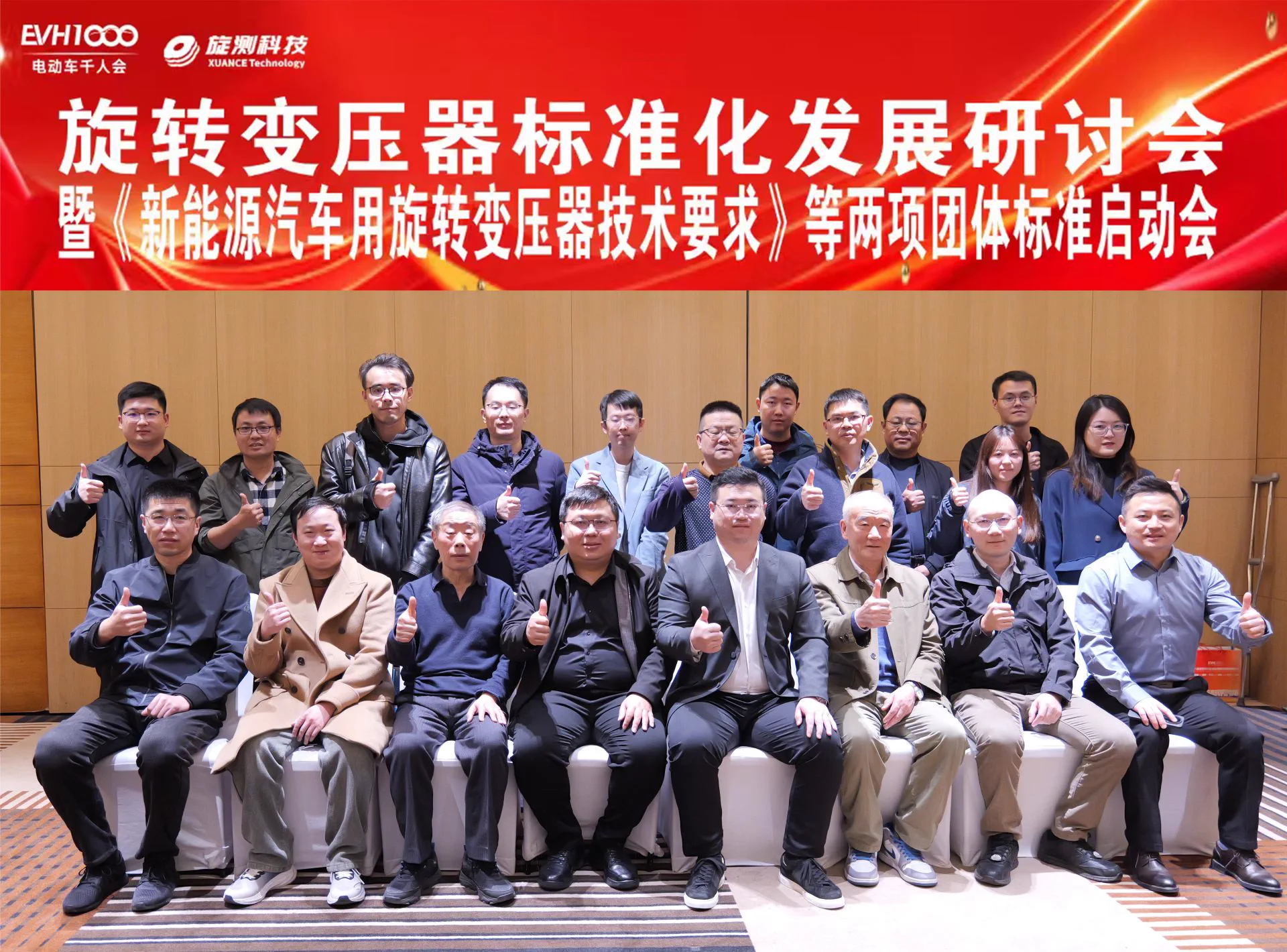
On December 3, 2025, the Resolver Standardization Development Workshop and the launch meeting for two association standards, Technical Requirements for Resolvers Used in New Energy Vehicles and Technical Requirements for Eddy-Current Angular Position Sensors Used in New Energy Vehicles, were successfully held in Jiading, Shanghai. The event was hosted by the China Association for International Economic and Technical Cooperation and its Standardization Working Committee, and co-organized by Hunan XUANCE Technology Co., Ltd. Representatives from universities, research institutions, automakers, component suppliers, and industry associations joined online and on site to witness this milestone in filling China's gap in resolver standards.
Mission-Driven: Standards First
As a precision electromagnetic angular sensor, the resolver offers strong interference immunity, high reliability, and excellent performance in harsh conditions. It has become an essential component in traction motors and EPS systems for new-energy vehicles. For years, however, China lacked a unified technical standards system, limiting standardized development and international competitiveness.
Chen Leshu, founder of Hunan XUANCE Technology, said that years of work in angular-sensor testing had made the industry's urgent need for standards unmistakable. As a principal drafter of both association standards, XUANCE is committed to applying its technical experience to industry development and collaborating on a healthier, more standardized ecosystem.
Liu Xutong, deputy secretary-general of the Standardization Working Committee, noted that competition among enterprises has expanded from products and prices to standards and industry influence. The two standards fill a domestic gap and support the national standardization strategy and new-industry standardization initiatives.
Expert Discussion and Practical Insight
During the technical discussion, experts reviewed the proposed requirements in detail.
Professor Huang Surong of Shanghai University analyzed resolver technology trends and the logic behind standard formulation. Tian Yuan, technical manager at Shanghai Yingshuang Motor Technology, offered practical recommendations on the usability and applicability of individual clauses. Fang Guangrong of Fitesa Automotive Components (Wuhan) contributed suggestions on eddy-current angular sensor requirements. Wang Fei, development manager at XPeng Motors, joined online and reviewed the standards from an automaker's perspective.
Representatives from Harbin Institute of Technology (Shenzhen), Zhejiang Liming Intelligent Manufacturing, Jiangsu Huaxuan Sensing, Ningbo Physis Motion Control, MinebeaMitsumi, and other organizations also contributed comments in a constructive discussion.
Exchange and Insight
Participants agreed that the workshop improved the draft standards and encouraged deeper thinking about resolver technology. Discussions covered high precision, miniaturization, integration, and applications in new-energy vehicles, industrial robots, and servo systems.
Moving Forward
Participants agreed that the two association standards will provide unified technical guidance for innovation and industrialization in China's resolver sector and strengthen the orderly development of high-end manufacturing.
XUANCE will use this launch as a new starting point for deeper industry collaboration, broader exchange, and practical standards implementation, supporting high-quality development of the angular-sensor industry.